Illuminati Card Game: History, Origins, Rules and Conspiracy-Theory Inspiration
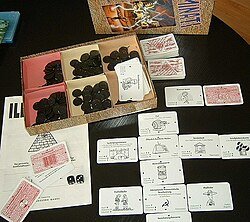
When people hear the word Illuminati, they often think of secret societies, hidden power, and conspiracy theories. But the word also refers to something much more playful: Illuminati, a strategy card game created by Steve Jackson Games.
The game takes the idea of secret organizations competing for influence and turns it into a humorous battle for world domination. Players create networks of groups, collect money, make alliances, negotiate with opponents, and try to gain enough control to win.
Rather than presenting conspiracy theories as established facts, the game uses them as material for satire, humor, and entertainment.
The story of the Illuminati card game goes back to the early 1980s and has connections to the popular Illuminatus! Trilogy by Robert Anton Wilson and Robert Shea.
What Is the Illuminati Card Game?
The Illuminati card game is a strategy and negotiation game published by Steve Jackson Games.
The basic idea is simple: each player takes control of an Illuminati organization and attempts to build a powerful network of groups.
Those groups can represent political organizations, businesses, cultural movements, mysterious organizations, fictional groups, and other parts of society.
Players compete through a mixture of:
Strategy
Negotiation
Money management
Alliances
Attacks
Diplomacy
Deception
Special cards
Random events
The ultimate goal is to build enough power to satisfy the game’s winning conditions.
What makes the game unusual is its sense of humor. Many of the cards are based on familiar conspiracy-theory ideas, but they are presented in an exaggerated and deliberately ridiculous way.
The Connection Between Illuminati and the Illuminatus! Trilogy
The origins of the game are closely connected to the ideas found in The Illuminatus! Trilogy, written by Robert Anton Wilson and Robert Shea.
The trilogy became known for its unusual mixture of conspiracy theories, politics, philosophy, satire, and fiction.
In September 1981, Steve Jackson and artist Dave Martin discussed their shared interest in the books.
The original idea was to create a game based directly on the trilogy. Jackson eventually decided against a direct adaptation because obtaining the necessary rights would be expensive and because the complicated storyline would be difficult to turn into a playable game.
Instead, he focused on the broader idea behind the books: secret organizations working behind the scenes and competing for influence.
That idea eventually became the foundation for Illuminati.
How the Illuminati Game Was Created
After deciding to build a game around the idea of secret conspiracies, Steve Jackson researched the historical Illuminati, conspiracy theories, and related subjects.
The game then went through extensive playtesting.
In July 1982, Illuminati was released by Steve Jackson Games in the company’s Pocket Box format.
The game was not designed as a serious explanation of real-world conspiracies. Instead, it used conspiracy ideas as the foundation for a humorous strategy game.
This distinction is important because the game deliberately mixes real names, fictional organizations, historical references, and completely invented ideas
The Secret Societies in the Illuminati Game
One of the most interesting parts of the game is the different Illuminati organizations players can control.
The original version included six major groups:
The Bavarian Illuminati
This group draws its name from the historical Bavarian Illuminati, a real secret society founded in 18th-century Bavaria.
Within the game, however, the group is part of a fictional strategy setting.
The Discordian Society
The Discordian Society is connected to Discordianism, a movement centered around the idea of chaos and the worship or celebration of the Greek goddess Eris.
The game uses this concept in its usual humorous style.
The UFOs
UFOs are another major part of the game’s conspiracy-themed world.
The concept allows the game to play with popular ideas about unidentified flying objects and mysterious forces influencing human affairs.
The Servants of Cthulhu
This group comes from the fictional world associated with H. P. Lovecraft’s Cthulhu mythos.
It adds a supernatural element to the game.
The Bermuda Triangle
The Bermuda Triangle is another famous mystery incorporated into the game.
Its inclusion reflects the game’s tendency to take popular mysteries and conspiracy ideas and turn them into humorous gameplay.
The Gnomes of Zürich
The Gnomes of Zürich are a humorous reference to the stereotype of powerful Swiss bankers and financial institutions.
Together, these groups demonstrate the game’s basic approach: take familiar ideas about secret power and turn them into exaggerated strategic competition.
How Does the Illuminati Card Game Work?
At its heart, Illuminati is about building a power structure.
Each player starts with an Illuminati organization and attempts to gain control over other groups.
Every group has different characteristics, including:
Power
Resistance
Income
Alignment
These characteristics affect how groups interact with one another.
Players can attempt to take control of another group, but they must overcome that group’s resistance.
Money and special cards can be used to strengthen attacks or defenses.
Other players may also interfere.
This creates an important social element because players cannot simply focus on their own cards. They have to watch what everyone else is doing.
Alliances, Deals and Betrayal
One of the reasons the game can become unpredictable is that players are encouraged to negotiate.
A player might help another player defeat a powerful group today and then attack that same player later.
Players can:
Form temporary alliances
Trade resources
Make deals
Help defend another group
Attack an opponent
Hide their real intentions
Turn against an ally
This means that the game is not only about calculating numbers.
Politics, negotiation, and psychology are also part of the experience.
The best strategy can change depending on what the other players are doing.
Money and Power in the Illuminati Game
Money plays an important role in Illuminati.
The game represents money using counters that symbolize large amounts of unmarked cash.
Groups can earn income and use their money to strengthen their position.
Money can also be used during attacks and defenses.
A player who spends resources carefully can sometimes turn a difficult situation around.
This creates another strategic choice: should you save your money for defense, or spend it aggressively to capture another group?
Why the Game Uses Conspiracy Theories
The conspiracy theme is central to Illuminati, but it is presented with a strong sense of humor.
The game includes cards and references involving ideas such as:
Secret organizations
Hidden governments
The Mafia
Mind-control technology
UFOs
Political conspiracies
Financial power
Strange organizations
Popular culture
Some cards are deliberately absurd.
For example, the game includes ideas such as Orbital Mind Control Lasers, as well as humorous references to organizations and cultural groups.
The purpose is not to provide evidence for these theories.
Instead, the game takes familiar conspiracy ideas and asks a playful question:
What if all these strange organizations were competing against each other for control of the world?
That is where much of the game’s humor comes from.
The Expansion of the Illuminati Game
The original game was successful enough to receive several expansions.
Among the notable releases were:
Illuminati Brainwash — 1985
Illuminati Y2K — 1999
Illuminati Bavarian Fire Drill — 2007
Illuminati Mutual Assured Distraction — 2010
These expansions added new cards, groups, rules, and possibilities.
A Second Edition was also released in 2018, updating some of the game’s references to reflect newer popular culture and events.
Over time, the expanding collection grew to include hundreds of official cards.
Related Illuminati Games
The popularity of the original game eventually led to several related projects.
Illuminati: New World Order
In 1994, Steve Jackson Games released Illuminati: New World Order.
This was a collectible card game based on the original Illuminati concept.
It became one of the company’s most successful product lines.
Illuminati: Crime Lords
In 2004, Illuminati: Crime Lords offered another variation on the basic concept.
This time, players controlled criminal organizations competing to take control of a city.
GURPS Illuminati
The Illuminati concept was also adapted for the GURPS role-playing game system.
GURPS Illuminati was released in 1992, followed by other related supplements.
These books allowed players to explore conspiracy-themed adventures in a role-playing format.
Hacker
Steve Jackson Games also released Hacker in 1992.
While it was not directly about the Illuminati, it used a similar style of gameplay. Instead of controlling secret organizations, players competed for control of computer networks.
The Illuminati Game and Popular Culture
One reason Illuminati has remained memorable is the way it combines serious-looking conspiracy themes with obvious humor.
The game takes subjects that can sound mysterious or frightening and turns them into exaggerated game mechanics.
That approach makes it different from a historical account of the Illuminati or a serious discussion of conspiracy theories.
The game is better understood as satirical entertainment built around the idea of secret power.
How the Illuminati Game Was Received
The game received a mixture of positive and critical reviews from gaming publications.
Reviewers often praised its combination of strategy, humor, negotiation, and conspiracy themes.
Some reviewers, however, felt that the basic game could become repetitive after many plays and believed that the expansion sets added useful variety.
Other reviewers appreciated how easy the game was to learn compared with more complicated strategy and war games.
Over the years, Illuminati developed a dedicated following and became one of the best-known games produced by Steve Jackson Games.
In 2007, nearly 25 years after its original release, it was included in the book Hobby Games: The 100 Best.
Awards and Recognition
The Illuminati series and its related games received several awards.
The original Illuminati won the 1982 Origins Award for Best Science Fiction Boardgame.
GURPS Illuminati later won the 1992 Origins Award for Best Roleplaying Supplement.
In 1994, Illuminati: New World Order won the Origins Award for Best Card Game.
The Illuminati PBM game also received several awards and was eventually inducted into the Origins Awards Hall of Fame in 1997.
Is the Illuminati Card Game About a Real Conspiracy?
This is an important question because the game uses the name Illuminati and includes references to real organizations and conspiracy theories.
The answer is that the game was created as fictional entertainment and satire.
It takes the idea of secret societies controlling events and turns that idea into a competitive card game.
Some of the groups and historical references used in the game are based on real subjects, while others are fictional, exaggerated, or intentionally absurd.
Therefore, the presence of a real organization or historical reference on a game card should not be treated as evidence that the game is documenting a real conspiracy.
Why the Illuminati Card Game Is Still Interesting
More than four decades after its original release, Illuminati remains interesting because its central idea is easy to understand.
People have always been fascinated by questions about who holds power, how organizations influence society, and what might be happening behind the scenes.
The game turns those ideas into something players can actually experience through competition and negotiation.
Instead of simply telling a story about a secret organization, it allows players to create their own fictional conspiracy.
One player might build a powerful network through money and influence, while another might rely on unexpected alliances or strange groups.
Every game can therefore develop differently.
Final Thoughts on the Illuminati Card Game
The Illuminati card game is a unique combination of strategy, humor, conspiracy themes, negotiation, and social interaction.
Its history began with Steve Jackson’s interest in the ideas behind The Illuminatus! Trilogy. Rather than directly adapting the books, Jackson created a new game built around the broader concept of secret organizations competing for influence.
Released in 1982, Illuminati eventually grew into a larger family of games, expansions, and role-playing supplements.
Although the game uses real organizations, historical references, and familiar conspiracy theories, its purpose is primarily satire and entertainment.
That combination of mystery, humor, strategy, and imagination is what has allowed the Illuminati game to remain a recognizable part of gaming culture for decades.